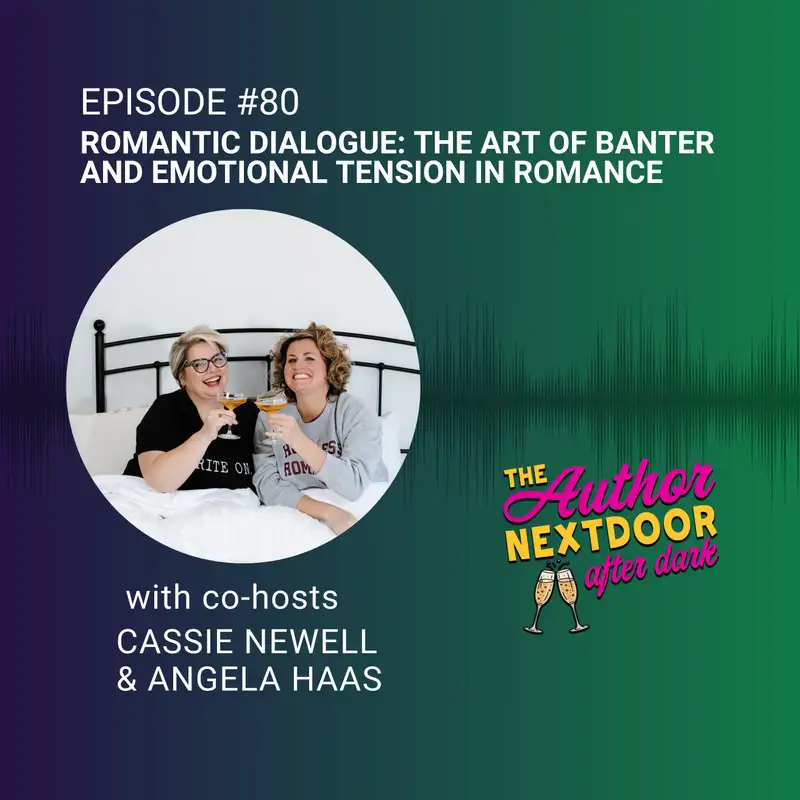
 Episode 80
· 42:43
Cassie Newell (00:27)
Cheers, my friend.
Welcome to The Author Next Door After Dark. I'm Cassie Newell and I'm here with my co-host Angela Haas. And tonight we're talking about one of the most addictive parts of romance: dialogue. because readers aren't falling for that first kiss all the time. They're falling for the conversation, the tease, the tension. It's all that lead up, right? So let's ⁓ talk.
Angela Haas (00:46)
Mm.
Cassie Newell (00:48)
about that when dialogue really works and when it just moves the story forward, pulling two characters closer together long before either of them is ready to admit what's happening. I love that part. So it's all the intimate moments in romance fully clothed. Like, okay yeah. All right so
Angela Haas (01:01)
Yeah, me.
Yeah.
Cassie Newell (01:11)
Let's ⁓ let's talk about the banter, the subtext, verbal tension, emotional exposure, and why the right line of dialogue can sometimes feel more intimate than the spice itself. So here's our leading question to kick us off. What creates more chemistry for you as a reader? The physical attraction between characters, or is it something they start talking about to each other differently than they talk to everyone else?
Angela Haas (01:37)
I think it's such a combo because I actually love all the little things in between the lines of dialogue. You know, sometimes they're trying to be coy or pretend and then there's a little something woven in like, how they're feeling internally. That internal dialogue, if you will, that
Cassie Newell (01:40)
Yeah.
Right.
Yeah.
Angela Haas (02:00)
shows what they're really feeling versus sometimes what they're saying because they're trying to pull off that hey I'm not that into you and then there's a graze of skin and then it's like ooh then their their internal dialogue versus their exterior dialogue for me that that's really where it's at. What about for you?
Cassie Newell (02:19)
Yeah. Yeah.
Yeah. I'm I'm very similar. I find that stuff very delicious because you're reading it on pay especially if it's in the point of view of a specific character that's kind of resistant. And or I guess it could I guess I could say that's the same for the character who's already aware of their attraction. Like they're saying something and then the subtext that's opposite in their head.
Angela Haas (02:35)
Yeah.
Cassie Newell (02:49)
You know, and you're reading it as a reader, going, You liar. You're so full of crap. You just said, especially in enemies to lovers or rivals to lovers, like, cause you you get that insight, right? Like you can't always see that on film necessarily. I mean, there's usually little moments or facial expressions that you're like, Okay, yeah, they didn't totally mean that, you know. ⁓
Angela Haas (02:53)
Right.
Mm-hmm.
Right.
Cassie Newell (03:15)
sarcasm, whatever it is, but in the written word you get that insight and it's so fun because you're like you're full of it. And I think that's why I like dual point of view.
Angela Haas (03:23)
Absolutely.
I do too.
Cassie Newell (03:29)
Yeah, 'cause you get to go back and forth, right? yeah, it's it's so fun.
I love too when I really get into a book and it's one POV, usually it's the female, and I get to the end of the book and there's some bonus or scenes that were from the guy's point of view that they give away. ⁓ I'm I totally click on that. I'm a slut for that. Like I love that so bad. 'Cause I cause you're right. Like I w I wanna know.
Angela Haas (03:49)
Yeah.
Yeah.
Cassie Newell (03:58)
Like I think I know, but then I I really want to see what the author was thinking. yeah, that's like one of my favorite things to do. There's a few authors that are really good at it. Shame on them, but like awesome marketing because I totally click every time. ⁓ that's
Angela Haas (03:59)
Yeah.
Yeah, exactly. Exactly.
Mm-hmm. Right.
No, those are always
the things that sometimes you don't think about when you're writing and then you read it and you're like, my gosh, yes, of course. I should have saved like maybe this scene and had this extra little magnet out of it. But yeah, something to think about. It's great marketing.
Cassie Newell (04:28)
Mm-hmm.
Yeah.
Yeah, absolutely. Yeah. Now I'm like, the Pink Tax Hmm Maybe I should do some extra things. so what makes banter actually feel romantic instead of just funny? Have you ever thought about that? And you're so good at this. I think you do this intuitively, so this might be a hard question, but
Angela Haas (04:42)
Mm-hmm.
I mean, I think, for me, because I'm number one strategic, I'm just it's like, well, what would this person say? Okay, well, what would this person say now? And then whatever kind of dialogue comes to me, it's kind of weird. I'm not planning it. I just like each line is just sort of coming to me. But sometimes, especially in those rough drafts, I look back and I'm like, this is so boring. This is not banter, it's boring.
Cassie Newell (05:16)
Yeah.
I feel that way right now.
Angela Haas (05:29)
And then I have to like spice it up
somehow, you know, or no, she wouldn't really say that next, you know, that no. So it actually it's kind of like whatever comes to me first, and then but I'm not planning it as banter. It just is sort of flowing. And then I just when I reflect and reread, I'm like, okay, that's good. Yeah, I like that.
I like that kind of exchange, you know, that dialogue. So yeah.
Cassie Newell (05:58)
Yeah.
Yeah, I think it what you're describing fits perfectly in whatever the plot or situation is. I think you well, how I perceive it when I've read your books, like they're in that moment. So I think you intuitively craft it in that moment, right? To move the story forward or get some outcome for the for the next area. Like there's usually character development though.
too which always cracks me up in there. You know, like it just kind of blossoms and you're like, okay. You know, I I think I like that the reason why I like those push and pulls. what I really like, okay, so I'm reading right now. I hadn't read any of Lexi Lexi Wood Woods? Wood or Woods, I'm sorry, before until now. And I'm reading Dr. Resident. and I needed some medical romances in my
Angela Haas (06:33)
Right.
Mm.
I'm gonna pull her up. Hmm.
Cassie Newell (06:55)
In my brain. And what I find really interesting, because I was thinking about this as we were coming up on our after dark, and it's interesting because it's very direct because one's a doctor, one's a nurse, ⁓ and how they interact with each other until it doesn't. And then he says something completely inappropriate at work and just the tables just turn. So it went from funny, funny, funny.
Angela Haas (07:09)
Right.
Cassie Newell (07:23)
Tension, tension, tension to whoa. Like you could be called into HR and like written up and all kinds of trouble. But of course, there's that moment of, you know, she throws it right back at him, which I kind of love females like that. You know? So I find it interesting, you know, that that emotionally intimate banner when it all of a sudden just
Angela Haas (07:39)
Gotcha.
Cassie Newell (07:48)
turns on you because it's no longer about a situation. It's like that reveal of I'm into you either sexually or lustfully or whatever that is. and I think that's why I don't know if you've I'm sure you've read these books where good girl becomes the the mantra and everybody's like
Angela Haas (07:50)
Right.
Cassie Newell (08:10)
You know, about that time when when a guy says that to a girl. it has to be in the right context though, because then it just doesn't play 'cause you're like, really? Yeah. I don't know.
Angela Haas (08:16)
Mm-hmm.
Yeah, totally.
And there's sometimes when, you know, it's banter, it's back and forth, back and forth, it's like tennis, and then someone just does a roll slam and you're like, Whoa, wow, that that took this in a completely new level where it's just like either, you know, sass being thrown back or, some sort of like trying to ignite like intimacy or something.
Cassie Newell (08:34)
Right.
Yeah.
Angela Haas (08:48)
I'm looking at these books though. So they are. This is interesting. What genre is this really? What is it?
Cassie Newell (08:55)
They're very spicy. I would call them contemporary romance for sure. ⁓ because they're there's no fantasy element to it, I would definitely say the spice level is quite high on the book one that I'm reading. but it f feels earned spice because there's conflict in there and a couple of other things, but yeah.
Angela Haas (09:12)
⁓ right.
Cassie Newell (09:18)
Peachwood Grove is gonna go to Peachwood Grove General. So I'm like, okay, I need to like get in my head ⁓ about how that's gonna work. So I'm kind of inputting right now, which is a great reminder too. When you find a book that you're laughing at and you're just like enthralled with, like pay attention to the dialogue. Right. Yeah.
Angela Haas (09:26)
Right.
absolutely. Yeah.
Well, and have you heard that of course I've seen this on Threads.
just understand that's where I'm getting all my information from now on. it has come out so many readers don't read anything but the dialogue. They don't read anything in between. They skip it and they just are reading dialogue.
Cassie Newell (09:58)
when I'm speed reading, that's
what I do. Uh-huh. I I'm a notorious speed reader. Like, especially now, I think because I understand I mean I've been doing this for a long time, but I really get story structure. So if there is too much prose describing a room or a forest or something, like I'm just like, I'm not in it. And I will just
Angela Haas (10:21)
Mm-hmm.
Cassie Newell (10:25)
bypass it to get to the to the meat
I do that a lot. You know,
unless a book just grabs me where I'm slowing down. Like yeah, I tend to speed read through stuff. Yeah. Guilty
Angela Haas (10:32)
Right. Mm-hmm.
Wow. I interesting. I mean I
don't I'd much rather just type dialogue, but then, you know, I think yeah. Mm-hmm.
Cassie Newell (10:46)
My first drafts are like that. I call it skinny drafting. Yeah. Usually
it's all dialogue. Well, and as you know, the first firefighter book, Embers of Fate, the first scene, their meet cute, I was like sending you dialogue because I was like, I'm gonna have her crash. And this and it's all about this crazy thing, but like how can a car crash be a meet cute? Like in the appropriately fun.
Angela Haas (11:01)
Right.
Right. Yeah.
Cassie Newell (11:11)
Contemporary way. So
Angela Haas (11:12)
Yeah. Mm-hmm.
Cassie Newell (11:13)
that was a fun discussion I had with the going back and forth with that one.
Angela Haas (11:16)
No, it was yeah,
that was really fun.
I'm just like yeah. Go ahead. I'm going down this rabbit hole of meta of this author and then now medical romance. So
Cassie Newell (11:20)
But like
I was just gonna say
Yeah,
I do like them. And what's nice is Lexi Woods, she is a nurse. and it's funny because because of my world, because I've worked in a hospital, I'm in clinical research in my day job, like all the things, I can kinda tell when people are skirting around the medical pieces. 'Cause I'm I have I love my departure of being a romance author, being an author in general, because it takes me out of that. But I can totally tell when people are skipping like
Angela Haas (11:42)
Mm-hmm.
Cassie Newell (11:59)
around, which is fine because to me it's departure anyway. I am not reading this to be a medical drama at all, you know, but I do love when I find out it's a nurse or a physician or somebody like that that's writing because I'm like, they know what they're talking about.
Angela Haas (12:07)
Right,
Cassie Newell (12:16)
But it these have been out a while. So I was just curious and I was like, Yeah, I've heard good things. And I knew one of the narrators that narrated one of the books. And I was like, before I dive in, let's just try book one and see what how it I'm pretty impressed. I like it. I won't lie. Spices nice. and the story's good too. So I'm enjoying it. ⁓
Angela Haas (12:16)
Yeah, yeah.
Right.
Right.
Interesting.
Cassie Newell (12:38)
I mean you know when you pick up a romance book, like the couple that's the couple, right? But I love when you're like, how are these two gonna end up together? Are these two gonna end up together? And I love that through the dialogue pieces. I'm just curious, when
Angela Haas (12:44)
Mm-hmm.
Yeah.
Cassie Newell (12:56)
tone shifts. Are you ever aware of that as you're writing it or as you're reading it? That whole that whole pivot point. Because in the beginning it's kind of playful. Yeah.
Angela Haas (13:06)
when they first start to like
finally be attracted or in love.
Cassie Newell (13:12)
Well, I think the in between part where it's quite clear they're on a romantic relationship journey. I don't know that they're quite in love yet, but that piece where it's like the meet cute, everything's fun and you're getting to know someone, especially if they're strangers.
Angela Haas (13:18)
Right.
Mm-hmm.
Cassie Newell (13:26)
I think this is more not second chance romance or friends to lovers. This is where you're strangers, right? And you've gotta pull that in. So I was just curious, you know, do
Angela Haas (13:30)
Yeah. Mm-hmm. Mm-hmm.
Cassie Newell (13:37)
Do you notice that when you're writing it, the tonal shift versus as a reader when you're reading and that tonal shift happens?
Angela Haas (13:45)
I do notice, I think as when I'm writing it, I know that there's something that's gonna break through the veil of their little Game of I don't like you. They always do that, no, I'm fine, I don't like you, I'm pretending. And then either, he comes to her aid in some way, she takes care of him, there's some there's always like a caretaker piece in there where
Cassie Newell (14:08)
Right.
Angela Haas (14:11)
especially with in the Hating Game that was one of the shifts that we were like, ooh, when they're out there, they're playing paintball, and then all of a sudden she gets sick and he's just there.
Cassie Newell (14:17)
Yeah.
Angela Haas (14:22)
there's that little hazy part where they're playing house or pretending that this is like what it could be, and then the next morning comes and they kind of snap out it but
And go back to their corners, So there's always a moment in there, when the banter is bantering, but then there's a little softer comment in there from one of them that's a compliment, or when they're sad, it's lifting them up or something coming to their rescue. And then that's I think when it starts to shift for me. Yeah.
Cassie Newell (14:57)
I think
it creates intimacy fast. I love that tonal shift where you can see it in the dialogue, and then all of a sudden the physicality of that usually it's a kiss. It's usually that first big kiss or that first big intimate moment, and you're kind of like, whoa. And usually one character's point of view is especially on a first kiss, I'm into this. I can't believe this is happening, but this is awesome or whatever.
Angela Haas (15:07)
Mm-hmm. Yeah, exactly.
Mm-hmm.
Cassie Newell (15:24)
Or I wanted this so badly, this is fabulous, you know, whatever direction that's going in. I love that tonal shift because to me that also signals it's gonna get intimate. We're gonna have some physicality of some of some kind at this point. Yeah, that's when I really notice it. I don't always notice it just in the dialogue or the prose itself until I get to a physical moment.
Angela Haas (15:35)
Exactly. Mm-hmm. Yeah.
Cassie Newell (15:50)
I see I think that way too and like movies, like you were talking about the Hating Game or even some of the other movies and shows I've been watching, it's that that first like pull pulling the person to you and that shock value, ⁓ usually that I really like. I think that kind of tells me, the tone has shifted No more no more playtime. So yeah.
Angela Haas (15:50)
Yeah.
Right.
Well how is it?
Right.
Talk about
how it is writing shorts though, because I mean I remember I'm try I I think I'm getting this right because I've read a few, but I want to make sure I've got this right. The
Which one are they in the kitchen and they're having a food fight and then that
Cassie Newell (16:35)
yeah, that's the very first book. Good job. That was a long time ago. Yeah.
Angela Haas (16:37)
That's what I thought, but I was like,
but that to me was as soon as it happened, I was ⁓ yeah, something's coming. It was that playfulness, there was banter, and then it was really fun. And then you kind of were like, Yeah. Right.
Cassie Newell (16:46)
Yeah.
Yeah, things fell on them. It was fo food oriented and there's lots
of laughing. And then there's a moment where he like licks the icing off of her face. I have to tell you, my oldest daughter hates it. She was like What is it with you and food? And I was like, This is a bakery. Like Anyway, ⁓ but a lot of other readers like were like, that was awesome because it was all of a sudden the tone shifted, right? But
Angela Haas (17:00)
Yeah.
Uh-huh.
Cassie Newell (17:16)
Again, I think this is maybe a tool in the toolbox is that it was time for for something to happen. No more talking about it. Something was happening.
that was a lot of fun to write. I did the same thing, well, not the same thing, but similar in sweet and spiteful rivalries. I have a pie eating contest. Yeah, I got the same comment from my daughter, like, what is it with food?
Angela Haas (17:31)
Mm-hmm. Yeah, that also.
Cassie Newell (17:38)
So if you've noticed, there has not been a lot of food outside of that. But I was at a bakery and I had a theme going and then it was lattes and then I had bitter tarts. So I had this theme. So in my head, I was like, this is brilliant. And it's like in the titles of everything. And my daughter was she was like, if somebody licked my face, I would be like, What is wrong with you? And I was like, I get that, but this is a
Angela Haas (17:47)
Yeah. Absolutely.
Of course. connects. Yeah. boy.
Yeah, I think they're yeah. Yeah.
Cassie Newell (18:07)
This is departure. This is this is fantasy. This is fiction. So anyway.
Angela Haas (18:12)
Well, that's
how I am with I can't I've said it before, I can't do makeout scenes in a public restroom. I'm just like the whole time my germophobiness is just triggering ⁓ and now her foot is touching the toilet seat. Nope. no, like and no, there's nothing sexy. Right. ⁓ there's nothing sexy, even if you're drunk and love starved, about a public restroom. There's just nothing there. I'm sorry. I can't suspend.
Cassie Newell (18:18)
Yeah.
Yeah. I hope she washes her feet really well. Yeah.
Angela Haas (18:39)
my disbelief enough to let that be a moment of his So we all have our things, I guess.
Cassie Newell (18:44)
Yeah.
Yeah, it's it's interesting that you say that because usually those types of scenes are like the the darkened scene from the dance club or the club and they like go you're like really there's a lot of people in there and no telling, like the sick drunk, all the things like mmm, yeah, it's not really all that sexy. Yeah.
Angela Haas (18:53)
Mm-hmm.
Right.
Yeah.
Right.
Mm.
Cassie Newell (19:08)
What about okay, so do you think readers fall in love with the romance or with the feeling of being deeply noticed? The reason I ask this question is because banter, usually is telling and giving information to the other character because they can't do it through osmosis of what they're thinking, right? So it has to be a verbal, a verbal back and forth. You learn more and the reader gets to experience that, right? By seeing the verbal
Angela Haas (19:30)
Right.
Cassie Newell (19:38)
back and forth, you're getting to know each other and all of that. So I'm curious as to your I know we've talked about this before too. Do you think readers fall in love with the romance part of it or the feeling of being deeply noticed?
Angela Haas (19:51)
Well, I think for me, the feeling of being deeply noticed is the romance of it all. I think that is the romance. And I think when you write or read that a character's truly being seen by the other person, that just so many swoony moments in those small moments. So I think that's I think that is the spark of
Wow, this person is different, or not who I thought they were. If you're writing rivals to lovers or enemies to lovers. Or it's the realization if you're writing friends to lovers that, wow, you know, I've been dating everyone else, and I keep coming back to the person who I feel safest with and who notices me the most. And I think that's that is the signal of romance.
Cassie Newell (20:43)
in your books, what I've noticed too is that it's clear when the characters notice one another. And and I think it's because there's an act of kindness between one character going, I n you just told me about this. I know this is gonna be hard for you. So I'm gonna support you in this way.
Angela Haas (20:54)
Right.
Mm-hmm.
Cassie Newell (21:02)
Specifically the first book, because they're going to all these wedding events, you know, and there's other aspects that they're learning about each other and things like that. And I think it's interesting because there's this vulnerable part about him and his brother's wedding, right? And she goes in all these major supportive ways, and he did some supportive ways in an
Angela Haas (21:08)
Yeah.
Mm-hmm.
Cassie Newell (21:26)
earlier in the book. But what I do love is when I have to say this, is when they put their foot in their mouth at some point. And you're like, dude, why do you think she did all these things? Or why do you think he did all these things? Like, duh. You know, I think for me, it's not so much about feeling noticed
Angela Haas (21:36)
Mm-hmm.
Right.
Yeah.
Cassie Newell (21:51)
or recognizing the notice, I like to see the story of it, which is a little bit the same. But I think what I like is seeing that development of it because that I love an arc. I love a character arc. You know, that realization part, that that full like light bulb, light bulb moment.
Angela Haas (21:56)
Mm-hmm.
Mm-hmm.
Right. I mean it's the
Cassie Newell (22:12)
yeah. And then you're like, shit, what did I do? Get them back.
Anyway so I yeah that's that's kind of how I think of it. I love too in dialogue. I'm I'm just gonna talk about this too. Compliments or observations in dialogue, because sometimes those things feel super intimate to me.
Angela Haas (22:27)
Mm-hmm.
yeah, even the smallest little thing, the smallest thing he or she observes about the other person and then and says later,
Cassie Newell (22:33)
Yeah.
Angela Haas (22:42)
it's that call back to, ⁓ yeah, we talked about this and you remembered.
Cassie Newell (22:47)
When you're writing tiny lines that hi you're trying to hit harder versus big declarations, it always has to be a callback. You have no other choice. It can't be like an a a small Easter egg here at the beginning of a the beginning of a meet cute and then later have it at the end. Like you've got to be a little repetitive because people won't get it. It's it's too fast. You don't have enough.
Angela Haas (22:59)
Right.
Mm-hmm.
Yeah. Yeah.
Cassie Newell (23:15)
pros
and exposition to kind of weigh it out to have it be super meaningful.
I think the mechanics work a little different in shorts.
Angela Haas (23:22)
Yeah.
Cassie Newell (23:23)
And I think to dialogue, it has to be tight. You just have no time not to be tight. and I've had places where I feel like I needed it to
Angela Haas (23:28)
Mm-hmm. Yeah.
Cassie Newell (23:36)
Especially in Bitter Tart Tempations I needed it to take up space a little bit because I had him more thoughtful and reflective about his life and his choices. And it was a grump age gap, but I can't have it take up like a whole chapter. Like I need it to like move here and then like the decisions have to go. So I do sometimes I overwrite things and then I'm I am a tactician.
Angela Haas (23:41)
Mm-hmm.
Right, yeah.
Yeah.
Cassie Newell (24:05)
and my influencing straights and I will just cut a bitch. I'll just like cut it out. So but yeah.
Angela Haas (24:08)
Had yeah. Yeah.
Yeah. Well,
and you have to be,
really efficient with your dialogue. Not that dialogue isn't efficient in longer novels, but you have room to fill space, and have a little playful scene and maybe something different and
always there's always scenes in every romance with like the check-in with the friends and you have to update the friends, right?
Cassie Newell (24:31)
Yeah.
Angela Haas (24:34)
And so you can do that a few times in a longer novel, but maybe only once in that short. So everything's gotta be very efficient in what you're conveying, So yeah. ⁓
Cassie Newell (24:45)
Yeah. And I think I learned
a lot of this from movies and TV shows. Because you're in a finite amount of time with those, especially if they're adaptations. And I know we'll talk about off campus later. But on on those things, when you hear a really good line, I don't know about you, but I like write it down sometimes. I've like get my notes out on my phone.
Angela Haas (24:50)
Mm-hmm.
Yeah.
Cassie Newell (25:07)
You know, because it does so much and such a short and I'm like, humans don't talk that way. We we befuddle, we mess up, we're word salad It like takes us a minute to to get things together sometimes when we're sorting out feelings. but I love it in shows and and in books where it's just so strong because you know, you're just like you have to get there and get there now. You can't befuddle.
Too long 'cause people lose interest. They start to speed read over it. Yeah. Yeah.
Angela Haas (25:35)
Right. Yeah, exactly. No, it can't feel
drawn out I mean dialogue moves the story forward, has to move the romance forward. so you can't just, have dialogue for dialogue's sake either. But I'm more attracted to dialogue that does match how we actually talk sometimes. I mean you can't do it always with romance. You have to have like the
Cassie Newell (25:49)
Right.
Angela Haas (26:01)
the grand gesture and the love declarations and things like that. But
when Harry met Sally for me as a master class in dialogue. And that's where I first was attracted to romantic dialogue that seems more realistic. but the telephone scene where they call their friends the day after they get busy is
To mean that's a master class in writing. And then it's just kind of fun. It's back and forth. It's how we talk. But then at the end, Carrie Fisher's character hangs up the phone and says, my God, tell me I'll never have to be out there again. And then Bruno Kirby's character says, You're never gonna have to be out there again. And it's just like truly intimate, loving moment. And I was like, Yes, you know.
Cassie Newell (26:45)
Yeah.
Angela Haas (26:49)
But it it came right after the back and forth of
Cassie Newell (26:49)
Yeah.
Angela Haas (26:53)
a conversation that felt like really happened. So yeah, that's
Cassie Newell (26:56)
Yeah. I think that's why I
like writing dashes because we pause. We don't complete a sentence all the time. I know I know that's controversial in the world, but like I think that's why I've always loved them. Because you don't have to finish a thought necessarily and it's not really that hanging piece of a ellipses. It's the but I you know, and then you you change this topic real quick,
Angela Haas (27:04)
Right. it's always pauses.
Yeah.
Cassie Newell (27:23)
I I love those. I love that.
Angela Haas (27:23)
Yeah.
I was so carried away with ellipses in my first novel. I think it was Amy who was like, What are you doing? I just had so many because I just was like, Well, they're pausing. it's just ironic that I just actually learned really how to use the dash really well. And then now that's a sign of AI.
So now I find myself taking them out sometimes, which I shouldn't it's it's a punctuation.
Cassie Newell (27:49)
Yeah. I think I use
them too much. I definitely my editor definitely pulls some out. And then it's funny because then sometimes I see, you it would have been better here, and then she'll pull them in. I love them. I think it's one of the best tools. I like that better than a semicolon pause, you know, and things like that. I just especially especially in dialogue. I catch myself a lot in dialogue or
Angela Haas (28:01)
exactly.
⁓ no, yeah, you can't have a semicolon. Right.
Cassie Newell (28:16)
a thought that is switching, I love it. Cause to me it's like you're traveling down the road and all of a sudden you take a right turn or left turn. You know, it's just kind of one of those. And then you may come back. You may do a U turn. You know, it's like one of those tools that I just kind of really enjoy. I do love to when dialogue leads to
Angela Haas (28:19)
Absolutely.
Yeah.
Cassie Newell (28:40)
spicy moments. Let's talk about this for a second. What do you think about dialogue, communication, and intimate moments? What do what do you think about those?
Angela Haas (28:51)
Well, at first I was like, Are we really talking this much?
And then it was an editor who was like, You need
Cassie Newell (28:54)
Yeah.
Angela Haas (28:56)
more dialogue here. And I'm like, Why? They're doing it.
But that was the difference, learning the fantasy of romance and the exchanges and depending on the level of romance, those
Cassie Newell (28:59)
getting it on.
Yeah.
Angela Haas (29:09)
little dialogue snippets in between can be really spicy or pretty tame but
obviously if you're writing dark mafia romance, that's where it gets a little crazy.
I just that concept was like so foreign until I started reading all these romances and I was like, yeah, they talk a lot when they're doing it. Yeah. What about for you?
Cassie Newell (29:26)
Yeah.
Yeah. Yeah.
Yeah. It's interesting 'cause I I like it. Like I think it's very titillating of having dialogue in intimate moments versus just an intimate moment. Because I don't know, I like the do you like this kind of thing or w what turned you on? What do you like? You know, as they're learning each other. That I find that really interesting. I love the praising.
Angela Haas (29:37)
Mm-hmm.
Mm-hmm.
Cassie Newell (29:56)
I think that's awesome. ⁓
Angela Haas (29:56)
Mm-hmm. Or when
someone just takes command and then just starts to yeah. Mm-hmm. Mm-hmm.
Cassie Newell (30:02)
yeah, is very c you know, dominant in those situations.
And I think dialogue serves really well there because sometimes you're like, wow, they said that and you're accepting that, where normally their personality outside of the bedroom is not to be submissive submissive. Those are my favorite. but I I do think dialogue adds like that titillation aspect more so than the actual words of the act.
Angela Haas (30:09)
Mm-hmm.
Mm-hmm.
Right, exactly.
Cassie Newell (30:29)
I find if you balance both of those, that's pretty awesome scene. You know, because usually what you're seeing is the act and internal thoughts of one character, one point of view. But when you start adding in the dialogue, especially if it's the opposite POV that you're reading, it adds context and subtext that you can infer, you know.
Angela Haas (30:32)
Mm-hmm.
Yeah.
Right. Right.
Mm-hmm.
Cassie Newell (30:56)
versus what the person's actually thinking, whether they're kind of lying to themselves about something or they're right on,
I find dialogue in those situations awesome. And I I think you bring up a really interesting point because in past romances, we're talking the eighties, early nineties, there was not a lot of discussion in the intimate scenes. No. No.
Angela Haas (31:16)
No, there wasn't. No one was talking. No, it was
maybe a little internal thoughts, but it was
just scenes of them, you know, rolling around there. that's something I really had to learn when I started reading contemporary romance.
But it's all about balance. There's some
Where the dialogue is going on for pages and pages, and I'm just like, come on.
at some point you gotta focus.
Cassie Newell (31:41)
You're like, honestly, you can't
Angela Haas (31:43)
The other thing that I would caution is it still has to fit who that character is. I've read a lot of mafia romance where
You have a younger woman, she's been scared, she's been mousy, she's been not very strong, and then suddenly they're getting intimate and she's this exhibitionist.
wait a minute, this there's no hint to this. And suddenly she's like going off the rails because she's so spicy. There was no indication that that was part of her personality.
Cassie Newell (32:07)
Right.
Angela Haas (32:16)
you have to make sure that it things can come out and that you know the love of a good partner brings things out of people, it can heal people, but if it's such a random shift and it there's no indication that's part of that personality,
that's a do not finish for me
Cassie Newell (32:34)
I also love in more modern day romances, because I think it's important for just the population of readers to know that they can ask for what they want. They can say no, they can, you know, request protection, ⁓ and all the things. And I love the consent.
Angela Haas (32:42)
Mm-hmm.
Right, yeah, mm-hmm. Consent. Yeah. Mm-hmm.
Cassie Newell (32:53)
discussion dialogue because that's a dialogue.
Angela Haas (32:53)
Right, totally.
Cassie Newell (32:56)
it's so controversial about protection. there are some authors that are like, I'm not writing about the condom. I'm not writing about birth control or anything because it'll take you out of the moment. But no, be safe. You know, sometimes you'll see these little things at the front of the book.
I don't know. I've written a number of scenes and I felt like I did a really good job on discussing that part and then hitting the road. Like it's a simple, it's a simple thing and you can make putting on a condom sexy. in my mind. I I don't think it takes away, but it's interesting because there are some that are like, no, I it'll take you out. Well I mean what are your thoughts on that?
Angela Haas (33:18)
⁓ yeah, absolutely.
Right.
Right. Yeah.
I have read those that I was surprised
well, I think it depends on what you're writing.
I see it more in romantic comedies and contemporary romance. But I think it just depends on your genre.
Cassie Newell (33:44)
Yeah.
Angela Haas (33:47)
I think consent is a bigger thing than protection these days. As long as you feel like you have two consenting adults, then maybe you can let that go. But I think one little thing about it doesn't take you out if it's one little sentence. If you're writing a paragraph about it, then
Cassie Newell (33:54)
Yeah.
Yeah, I think the anticipation
is more powerful than the payoff. Like, and that's where I think dialogue can be really strong. And then if you're in the point of view of one character where it's a like something's a turn on as a result of what they've said, you know, either you're staring or it'll fit or these good girl all the things we've seen like a thousand times.
Angela Haas (34:08)
Right.
Mm-hmm.
Right.
Cassie Newell (34:29)
But those, you know what's coming. Like it's it's that anticipation piece that I think readers love. And I'm okay with repetitiveness on that side because I've read those things like a million times. They're almost they almost become tropes. Like I've seen in marketing where romance authors will
Angela Haas (34:31)
Right. Exactly. Yeah. Mm-hmm.
Cassie Newell (34:49)
claim it as a trope kind of thing. he said girl girl. That is not a trope, you know.
Angela Haas (34:51)
Mm-hmm.
No,
Cassie Newell (34:55)
But
Angela Haas (34:55)
yeah.
Cassie Newell (34:57)
it's great marketing because
in the right genre, the right spice level, the reader knows exactly what they're getting. Right? So
Angela Haas (35:00)
Mm-hmm.
Yeah. Mm-hmm.
Cassie Newell (35:05)
I'm gonna go po polar office opposite here with a couple of questions like, why are almost kisses so effective? Like versus these things, like that that pullback.
Angela Haas (35:13)
Well
I mean, for me, I like the build up. I mean, the build up is everything. When they finally do it, you're like, okay, well, what's now? What happens now? You know, because the build up is everything, and especially if it's an almost kiss, you're kinda on the edge of your seat. is it finally happening? Is it happening? And then yeah. Mm-hmm. Then it keeps you turning pages to see, okay, well, when is the first kiss coming?
Cassie Newell (35:24)
Yeah.
That restraint. Mm-hmm.
Think that's where I think dialogue can feel more erotic in those explicit scenes or the more intimate scenes than the almost scenes.
Angela Haas (35:49)
Mm-hmm.
Cassie Newell (35:51)
because usually there's a befuddleness, like, I'm so sorry. I shouldn't have done that. Like, I love the Hating Game for for this example because there is so much sexual tension, and then they're in this elevator, but you can tell it's on his side, like she's just not quite.
Angela Haas (35:56)
Right.
Mm-hmm.
Right.
Cassie Newell (36:07)
on in the same pl playing field as him. And then there's this huge kiss, like a blow up kiss, right? That's so awesome. And she's to like that moment of, okay, I'm into this. What's happening? You know, and she just kind of goes with it. But at the end, he's setting her down and he's like, I am so sorry. Like, you know, but then he's driving her somewhere thinking things have changed and she's like, nothing's changed. You know?
Angela Haas (36:09)
Mm-hmm.
Yeah, so it was so great.
Right.
Yeah.
Yeah.
Cassie Newell (36:37)
Because she she's not on the
Angela Haas (36:38)
Yeah.
Cassie Newell (36:39)
same playing field, but I love that because there's not a lot of dialogue. There's a lot of breathing space of how she's perceiving it. And actually the book, it's all from her point of view. So it's it's really interesting when you compare
Angela Haas (36:50)
Right.
Cassie Newell (36:53)
movie versus the book. But I do think those moments where you give in and then there's a pullback.
Angela Haas (36:55)
Right. Yeah.
Mm-hmm. Yeah.
Cassie Newell (37:00)
is pretty awesome too. And
I think dialogue serves a really good purpose there because if it would have if her dialogue would would have been on the same page as his, the scene would be completely different. Yeah.
Angela Haas (37:14)
Totally. Well, it's that
retreat. It's come together and then ooh, that was too scary. That was almost like love. Let's retreat. Put on our masks and keep trying to fight it. it's that and then the dialogue of like, it didn't mean anything, whatever, I still hate you. Or, you know, yeah. Yeah.
Cassie Newell (37:18)
Mm-hmm.
Yeah.
Yeah, exactly.
And that's
that dialogue that stops hiding, right? It's it's that like reveal moment,
Angela Haas (37:37)
Mm-hmm.
Cassie Newell (37:39)
where you're actually communicating
I love those like examples where it's like I didn't mean for this to matter or I miss you or don't make me say this if you're gonna leave kind of stuff. I love those kind of lines too.
Angela Haas (37:49)
Right.
Cassie Newell (37:54)
What makes a line unforgettable emotionally for dialogue? Is is there something that makes it emotionally tied that's just unforgettable for you?
Angela Haas (38:06)
I think those come more at the the grand gesture, the final love declaration for me. It's when they just finally can't take it anymore and they just everything that they've been trying to hide or conceal or avoid just starts saying, it's that that fuck it moment, where they just say, I've just gotta tell you this and
Cassie Newell (38:28)
Hmm.
Angela Haas (38:31)
it gets emotional because they can't take it anymore. And they realize I'm in love and and you're gonna know about it. And and those are really special lines for me at the end. Yeah. What about for you?
Cassie Newell (38:39)
Yeah.
Yeah. I think
for me the unforgettable line is like
Yeah, I think it's the declaration, but I also like the promise. Especially if it's a second chance romance. I love those promises. I will make this better or I'm not this person anymore. I'm so sorry for this. Like, because I want this, I want this. Like I like those. I suppose they are declarations, but it's not usually at the end end because
Angela Haas (38:55)
Mm-hmm.
Yeah, absolutely.
Yeah.
Sure.
Cassie Newell (39:14)
you're
still having to convince the other person that they're giving into the second chance opportunity.
Angela Haas (39:16)
Mm-hmm.
Cassie Newell (39:19)
So I think I I really like those two. yeah.
Angela Haas (39:19)
Yes.
Cassie Newell (39:23)
And I love when dialogue stops being flirtation. You know? I love like what you were talking about, that give and take and that that playfulness. And I love when all of a sudden that stops in romance. Like I love it so much. Like I can't get enough of that. And I love that in shows too. Cause you can see that pretty directly there too. the actors usually or the directors, whoever's guiding the guiding that aspect. You you usually can
Angela Haas (39:27)
Mm-hmm.
Yeah.
Right.
Mm-hmm.
Cassie Newell (39:49)
physically see that too. So
Angela Haas (39:52)
So what's
a show where that has happened that you just loved it?
Cassie Newell (39:55)
next month when we talk about Off Campus I think you'll see the shift specifically in Garrett Graham, which is the main male character. You will see that shift. You will see that he falls first and he falls hard and he w he doesn't recognize it. That's awesome. That actor does such a great job. But there's also ⁓
Angela Haas (39:58)
Mm.
Gotcha. Yeah.
Cassie Newell (40:23)
one of the other hockey players that you see that with too. So they show both of those aspects that I think are done quite brilliantly. I also think, you know, Love Hard does really good with that. That was one on Netflix that my husband and I, we watch like every Christmas. It's just become a thing.
Angela Haas (40:26)
Mm-hmm.
Cassie Newell (40:42)
I love that so much.
So this was so fun. Thanks so much. ⁓ yeah, I love I love when we get to chit chat about what we write about and romance, because yeah, it's just fun. So
Angela Haas (40:47)
This was so great. Yeah.
Absolutely.
Cassie Newell (40:57)
Next
month on After Dark, we're diving into power dynamics in romance and why chemistry is never completely random. So we're talking about control and vulnerability, the emotional push and pull, why certain pairings create explosive tension, and how power constantly shifts inside a romance relationship. And we're doing all of this comparing Off Campus the entire season one.
Angela Haas (41:23)
Yes, we're gonna talk off campus.
Ooh.
Cassie Newell (41:26)
So everything
we talk about is going to be related to off campus. You're not going to want to miss this one. It's going to be so fun. So fun. I love this so much. Cause I think we've talked about power dynamics, right? And other aspects in earlier episodes. So it'll be fun to compare. So if you have not seen off campus and you're like, assignment one, go watch it.
Angela Haas (41:31)
Yay. You're not gonna wanna miss it. It's gonna be so exciting. Right. I'm so excited. Yeah.
Assignment one, go watch off campus and join us back here.
Cassie Newell (41:54)
And then come back for episode six. All right. This is where things are gonna get really interesting. It's gonna be so much fun. We get to fangirl about the whole hockey team and I am bringing you into my hockey love.
Angela Haas (42:02)
⁓ yeah. Mm-hmm. We're gonna really break it down. I
gotta get on the train. I gotta get on it.
Cassie Newell (42:14)
You gotta get on the train.
And then Angela's gonna be like, I need to write a hockey romance. ⁓ Amen, sister. Till next month. Keep writing, keep doing. Bye.
Angela Haas (42:19)
God, please no, I can't. ⁓ You never know. Never say never.
We'll see
ya.
Listen to The Author Next Door using one of many popular podcasting apps or directories.